Dev Pods: Flexible, sustainable collabs in Godot without gen AI
"Who wants to team up to make a game?"
Have you seen posts like that on Discord? Or been part of a game jam team that stayed together for a longer project?
Either no one responds, people move on and can't be replaced, a year passes, there's no release date, or - a newer issue - someone ruins the game by using AI until it's such a mess that people give up and experienced developers won't go near it.
We've released 100% of the games we started since 2015, on time, each made by a team over 2-6 months
Dev Pods collabs work very differently than how people think about teams. Each game has a lead - any member up for following the steps of our process we teach - who built the prototype as a starting point, planned the tentative schedule using our format, and coordinates peers who want to be involved. That person accepts responsibility to see the game through to release.That enables freeform collaboration. Everyone else floats. No one is assigned tasks or stuck to one game, each person gets to do what they want to. People can switch games, disappear during a busy week, or drop a task they started if they aren't feeling it.To people unfamiliar with our community, that may sound like a mess, doomed to fail. Here are 240 games we made this way.The difference is the training and advising that goes into our method. Members who choose to lead learn from our included video course and calls with an expert to prepare the steps needed to complete a game in this approach. All members go through on boarding on how to navigate the systems we use for every game. We invented this process and provide direct support.Some members describe Dev Pods as a sustainable, flexible, year-round variation of game jam culture. Game jams are great, but hard for many people with a full-time career and family life who can't disappear for 48 hours of dedicated focus. Our flexibility makes this a good fit for someone who has just a few hours for gamedev most weeks. Members use what limited time they have in a way that fits with how teammates spend their few hours a week, too, adding up to a game ready to release. Our system makes it so people can jump in when they have time, but it's also ok and normal if there are some weeks when they don't. Although long-term game jams exist, what Dev Pods offers that those can't is a professional gamedev educator who is personally getting to know members and ensuring all games come together, that everyone knows and follows a consistent process, and AI use is kept at bay.
Why teaming up works better in Dev Pods
-
Games all release, on time Knowing the game will not fizzle out helps people get more involved without holding back
-
Bigger than game jams Projects are made over 2-6 months, which leaves room for bigger scope and learning as we go
-
Experienced teammates 4-15 people get involved on each game, most of them have already finished a few games together
-
Everyone self-directs Pick a task from a game schedule, or if there's something else you'd like to do leads are often up for it
-
Games turn out different because of you If you make an enemy, level or item you decide how it looks, works and sounds
-
No commitment or obligation No minimum weekly time, just fit in what you can, peers fill in to keep games on track
-
We recruit for you We bring in people year round, if a contributor to a game moves on others are around to fill their shoes
-
Leads aren't "bosses" Leads build the prototype and schedule, post weekly updates, do a lot of the work and fill in gaps
-
You own your work When you make a song, model, code, etc you still own that to reuse (even sell) later, no one else can
-
Make your own games Jobs involve making what a boss or customer wants, but we make games that we want to make
-
No work is wasted Commercial games cut for quality, here if something is contributed we use it, and credit it clearly
-
Professional guidance An expert ensures every lead is prepared, teams have support, and everything is taken care of
What games have been made in Dev Pods
A note about our purpose and priorities
In Dev Pods we make free games to learn and have fun. When a commercial studio makes a game, candidates have to be interviewed so music, levels, UI etc are only done by people already qualified to do it well. In our group, if someone makes their first song, level or UI design, we're proud to include it in the game. People skilled in one area are equally free to try others.Despite how that might sound, our group has some made games that impress industry professionals. One reason is there are members in our community who joined when they were new to making games, but years later are still involved, now well beyond their first time in Blender or Godot. A few members have professional game development experience but enjoy Dev Pods for creative side projects. Another factor is impact on the final game is roughly matched to experience level, since a beginner may take several days to figure out something an experienced person can do in one sitting. This is actually another benefit of us not using generative AI, since AI helps a beginner affect a lot more files faster, quickly outpacing their understanding of the effects.Speaking of AI: despite its reputation for low quality, there are things AI might do better than a beginner, or at least faster. But we aren't focused on what makes the game a little better now, we care about what makes the people involved better, long-term. In Dev Pods people are encouraged to make beginner errors to learn from, or take their time building a feature the way they want to - even if this means the game ships with some human imperfections or fewer features. That's a trade we favor every time.Here's what our games are like, through gameplay clips while some members talk about their experiences in our community:
Games above include ones we made with Unreal 5 or Unity, but in 2027 we'll only use Godot for new games due to Unreal and Unity's growing AI use.
Prefer a deeper dive? Here are members talking about what was valuable from being on 1 of the 14 games we made in 2026:
You can browse or play all of our games free on itch.io 🎮
Every game we made is in that ☝🏼 collection. They don't all load at first, each time you scroll to the end more rows will appear.
We don't use gen AI on games in Dev Pods, for the same reasons we never used outside assets
Members don't want AI used in Dev Pods. In addition to no AI art, audio, or text, we also don't want AI code, AI placeholders or AI concept art. We ask (though know this is not 100% enforceable) members to please not use AI in Dev Pods for brainstorming, troubleshooting, making sense of code, or editing text. We prefer these be done the old (2022ish?) way, or ask another person.
There are a handful of games in our collection with traces of AI use, mostly when it was emerging and concerns we discuss today weren't widely known yet. We don't hide them as they're part of our history and learning. A couple members tried AI in small ways in 2023, which soon led to our first policy restricting AI use. As AI keeps expanding into established workflows (code in google search summaries, IDE copilot, generative fill) we've updated our policy to request members not use those with Dev Pods games, either.
Locations of the 500+ members credited on released Dev Pods games
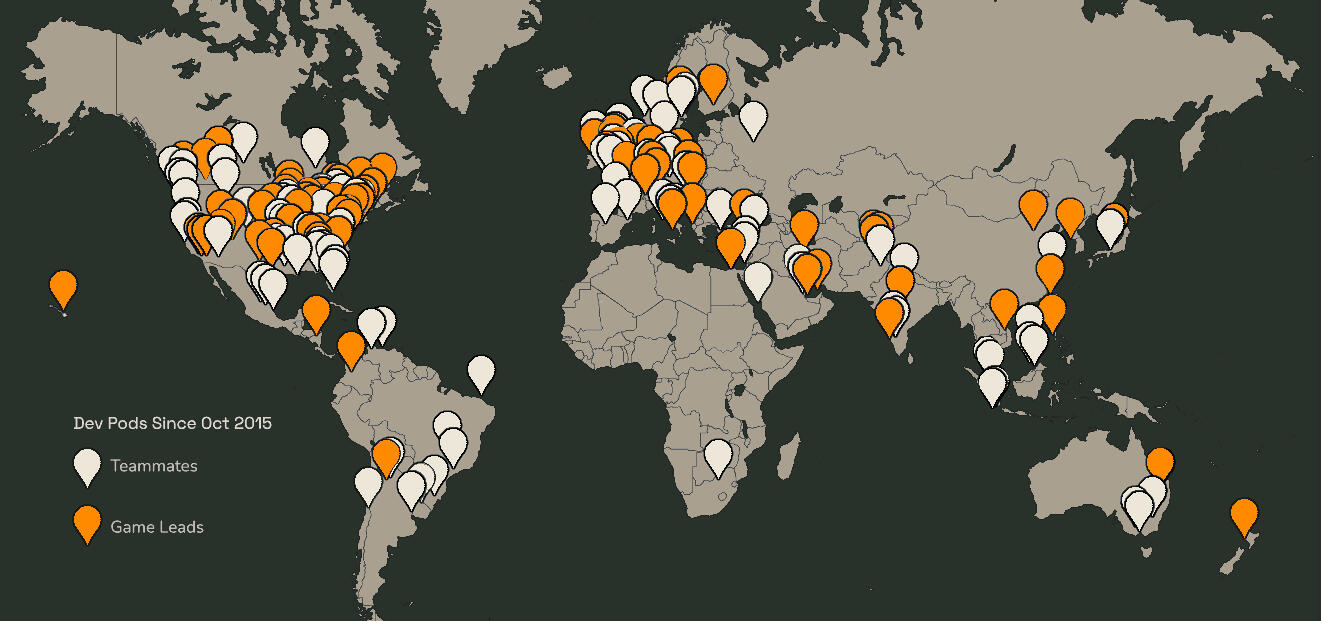
This map is cumulative from 10+ years of people in our game credits. Many pins on major cities overlap too densely to tell apart.
Dev Pods never has and never will feel crowded - as we grow we split into subgroups to keep community groups neighborhood-scale.
Who runs Dev Pods and why
Hi! I'm Chris DeLeon 👋🏼

I grew up in St. Joseph, Missouri, where I had amazing friends and teachers, but it's not a place where I found people to team up making games. After a few years making games solo, I tried teaming up online. A few months into that, the lead lost his files. I went back to working alone.In 2004 as a college freshman I found a new club for people who wanted to make games. Ideas were pitched, but nothing got made yet. I had a 6-7 year head start, so I came up with a process for us, which about 7 teams used to finish games each semester. This was before modern game engines or YouTube, so we had figure things out together, mostly using C++ without an engine.After several years in the game industry, I grew interested in education, so I went to grad school. I soon started a second gamedev club there, in 2010. It was also promptly finishing about 7 games every semester, too. By then we were using Unity and Flash.Seeing how those clubs helped people, and not just the ones doing a career in games, I left the PhD program to adapt the same methods to be available for more people. It took some changes to work for busy adults outside of university, but that's Dev Pods.
My background has prepared me well to help Dev Pods members. I'm a...
Testimonials

"I am thankful to have found this community not only because of the technical skills it's teaching me, but also the mindset it's helped me find, and the extremely positive atmosphere that's been cultivated which encourages people to try... I've gotten more comfortable with the fact that it's okay not to know how to do something. Before, it felt like a stumbling block, but now I understand that that's just a part of the process, and a rather enjoyable one at that because when you do figure it out, you feel like a genius."
Jenna Johnson

"I love how a project has momentum. If you're busy, the team keeps making the game better! When return to the project, you get this amazing jolt of energy and motivation from seeing all the improvements made while you were gone!"
MrPhil (Philip Ludington)

"While I come from a technical background, Dev Pods gave me the skills and mental framework to work with a team in a collaborative, positive way. In particular, I came away with the ability to break a project down into features, split that work in a cooperative fashion, and not obsess about people working in 'my' code."
Mike LeSauvage

"I was in various Discord groups, everyone's trying to build portfolio. The difference between those groups and Dev Pods is that this is the real process of game creation, down to production and organization you have in your Trello, down to the creation process of GitHub pushes, building a real experience."
Iain Hurt

"I found Dev Pods while trying to find projects that were less intense than game jams and with the opportunity to work in more detail in the projects. After several attempts of putting a game dev team at my workplace, I found Dev Pods and it was just what I was looking for. It was a place to learn about things that I had never done before like version control. I feel the most important thing is to learn how to work with other people in a long term. Such experience is difficult to replicate in my bedroom. I think that's what makes this community special."
Alfonso Salinas

"This is a game that I've had in the back of my mind since I was a kid, thinking man, I wish someone would make this hockey game. Now we've actually made it. I really can't thank you all enough, everybody who participated in it and helped build it out week by week. We started with that really basic [prototype], turning it into this awesome piece that it is now that I'm so proud of... it's been a joy making the game."
Patrick J Thompson

"I accomplished more in four months here than in four years at my college game dev club."
Dan Dela Rosa

"I joined, contributed to a few projects, and before I knew it I was pitching and leading my own. I learned about the process of managing development from end to end, programming techniques to write readable code, and the inner workings of the engine. Thanks to Dev Pods, I can go around telling people that I shipped a game! That’s amazing, and I am so happy to have had the experience. Really showed me how to game dev in a way that is sustainable and fun."
Bjorn Talbot

"Doesn't matter what your skillset is, working in a team you learn a lot that you wouldn't be able to do working by yourself. I can't really say enough about how important this is for anyone that's wanting to learn to make games, and get to know other people that also enjoy the process of making games."
Renaud Marshall

"I no longer have to do everything alone. It also pushes me to keep practicing, to give weekly check ins and to ask for help when I need it. There are people in the group that are just starting out making their first game, while others are active members in the game development industry – everyone is equally valued and everyone tries to help build everyone up. Whatever role you want to practice on a project, you can. After being in the group for over a year and a half, I have been involved with 11 projects doing a variety of skills (some of which I am terrible at, but I wanted to practice)."
Dani (Cassidy) Noble

"Game development is what I always wanted to do. It was the reason I entered computer science. Unfortunately my career path trajectory did not enable me to enter the industry. Dev Pods has enabled me to learn a variety of game development skills, meet like minded individuals and contribute to a multitude of shipped projects in a short amount of time. There is an emphasis on teamwork and there are no wrong questions. This is a great community to be a part of to learn game development. My skills have increased tremendously!"
Fahad Muntaz

"Initially, I didn't have any plans to program, or even touch coding at all. But after joining Dev Pods, I was able to learn how to code. Everyone is here to learn and develop games together in a super positive environment. Nobody is held responsible for making mistakes, because everyone in the team will try to fix it together and find out what went wrong as a team... That is part of the process of learning."
Charlene A.

"Prior to Dev Pods I thought that I would be missing something by working with others. Perhaps some part of me thought it was lazy or that I would lose something by not having total control of a project. Working with diverse teams changed that thought process quickly. Right away I was making games with teams in different time zones all working towards a shared goal. It was amazing to see how much could be done in such a short time with proper communication, organization and leadership. After about a year at Dev Pods I didn’t care to work alone much any more. It sounds silly to say now but as long as you have the skills to work well with others you can create so much more. The confidence gained from Dev Pods allowed me to join up with some other local devs, organize and participate in game jams and make some lasting development relationships. I feel ready to jump in with any group of people and be able to contribute to a project. If I had to do my game dev training all over again I would have started with Dev Pods. The mentorship and the context of doing everything via deliverable projects is so powerful that nothing has compared. After spending a year working in teams I can much more easily take those skills back to personal projects and prototypes."
Brian Nielsen

"The experience with Dev Pods has really been very helpful for me, especially in terms of learning how to collaborate with members & team leads and learning from them along the way. The opportunity to lead a project and learn along the way really helped me get involved and learn through experience. During my college years we were only taught concepts, but we were not guided to build projects. The teaching approach of building projects helped me understand how things work in real life. Making mistakes is part of the journey. One of the things that Chris said is, 'You will not get better at a skill that you are not trying to use.' "
Rodrigo Bonzerr Lopez

"I've done a few game jams. Dev Pods is exactly the thing I was looking for to help me take that next step in my game dev journey. I've been a member for six weeks, but long enough that I've seen how things work and I was able to contribute to several different projects. Everything has been great and it's matched or exceeded my expectations. The onboarding was great. There's a bunch of videos that you get right away that you get to go through and they explain how the community works, how it does game development. The whole framework for bringing a game from ideation all the way to releasing it on itch.io on time, that's a huge benefit. It is simple, not overbearing, not like a bunch of complicated tools and processes, [or] time spent in admin stuff that no one wants to do. The actual members were very welcoming, very nice, never any bad interactions or undue pressure put upon me to do something I didn't want to do or anything like that. People are eager to lend a hand, answer questions, brainstorm. It's chill, it's fun, it's interesting. If you're hesitating, don't. Join up. You can kind of try out Dev Pods without too much pressure until you figure out if it's the right thing for you."
Philippe Vaillancourt
Membership is 1 month at a time, you can cancel with a click, and we have a 30-day refund option so you try it out with zero risk
Past names: In 2015 this group started as LAGameDevs. In 2016, it became Gamkedo Club when going remote. In 2019, we turned into HomeTeam GameDev by adding tutors, but the extra support required higher membership dues. In mid-2025 we rebranded and streamlined as Dev Pods. Tim Ruswick was involved for about one year into our Dev Pods pivot, but has moved on to other projects.
This page was improved with feedback from members Amanda Stanley, Christian Gabbianelli and Mark Guinn
The organizer Chris DeLeon can be reached by email at chris@DevPods.gg
If you joined before our 2025 upgrades and wish to exit you can unsubscribe in PayPal.
Privacy Policy | Terms & Conditions
©2026 Brave Lighthouse, LLC. All rights reserved